This Week in AI
The AI Slowdown Debate — and What It Means for Your Business
Washington turned down requests from AI leaders to slow down. Markets fell, and paying customers filed lawsuits. Plus an AI that speaks 97 languages.

Two things happened in AI between September 14 and September 20. Each one is worth five minutes if you run a business.
One is about who gets to set the pace of AI development. The other is about what AI can actually do once a customer starts talking.
Washington pushed back on slowing AI development
The debate started before the week did. Anthropic CEO Dario Amodei suggested slowing progress on the most powerful AI systems so safety work could catch up. His proposal included independent evaluators inside AI companies, shared standards, and international cooperation. He drew a line between that and stopping technical progress.
On Friday, four paying subscribers sued Anthropic, OpenAI, Google, and SpaceXAI. They argued that planning a slowdown broke antitrust law and lowered the value of their subscriptions. The complaint is about competitors coordinating, not about one company being careful on its own. These are allegations, not a ruling. The Associated Press reported the suit.
On Saturday, President Trump opposed a slowdown and said he planned an "AI Force" and an AI czar. CBS News reported the remarks.
What this means for your business
This week did not settle how fast AI will develop, or how it will be regulated.
That distinction matters. Arguing about the next generation of AI is not the same decision as whether today's tools can help your business.
You can already check whether AI saves your office time — preparing quotes, organizing customer information, drafting follow-ups. You do not need that debate to finish first. The same is true of the camera button most people never press: it works on the phone you already have.
Pick one recurring task. Measure how long it takes now. Try the tool, review the result, and count the time spent fixing mistakes.
That gives you evidence about your team, not a prediction about the industry. If you want a way to choose which task to start with, the first workflow worth automating is the filter we use.
Google introduced voice AI that can switch languages mid-conversation
On Tuesday, Google introduced Gemini 3.8 Live and Gemini 3.8 Live Extended Thinking.
Google says the models support 97 languages, can switch languages inside one conversation, can use live visual input, and can keep a conversation going while they work on something else in the background. Rollouts cover developer tools and consumer products, and availability differs across them.
Google also highlights accuracy on combinations of letters and numbers — confirmation codes, claim numbers. That is a stated capability. It is not a guarantee that every detail lands correctly on a real customer call.
What this means if you take calls in more than one language
If customers start in English and switch to Spanish halfway through, this is the shape of product worth testing — an AI receptionist included.
The model is only one piece of the system you are buying.
A call has to go right from start to finish: understand the request, record the right information, check availability, and hand the call to a person when it should.
Before you buy, ask the vendor for a recording of a call in which the customer:
- Switches languages halfway through
- Corrects their address or phone number
- Asks for an appointment that is not available
- Asks to speak with a person
Then look at what landed in your calendar or customer record. A natural-sounding conversation only helps if the work it produces is accurate.
What to do with this week's news
The policy debate is still open. Google's release is another set of capabilities you can test, not a reason to rebuild the office around an announcement.
You do not need to follow every one. You do need a way to decide which ones matter.
Start with a problem your team already has. Test whether a tool helps. Expand when the result justifies it.
If someone offers an AI receptionist, ask whether you can try it on a few of the hard calls your team already gets — and then check what it writes down. That tells you more than a polished demo.
Aristotle Taylor is the CEO and co-founder of Levron Partners. We find where an operation is leaking hours, then build the software that removes them.
Keep reading
Guide
The Question Your Office Answered Five Times This Week
A homeowner calls about an install quote. Then another texts about the warranty. Someone else wants to know what happens after the inspection. Your team knows the answer. It may live in the estimator’s head, an old text thread, or the office manager’s memory — so someone stops, checks the details, and types it again.
Guide
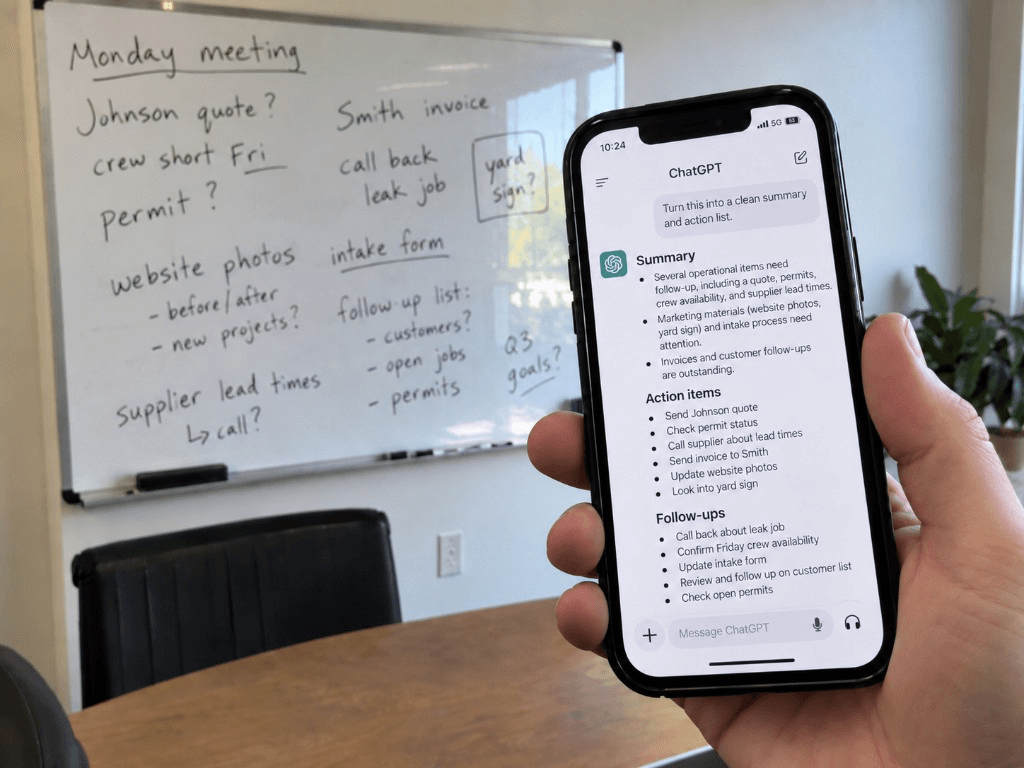
Stop Retyping Things That Are Already on Paper
Every AI app has a camera button. Most people have never pressed it. Here's what it actually does — and where it's genuinely useful for a trade or service business.
Guide
The 5-Minute Rule: What Slow Lead Response Is Costing Your Trade Business
Leads contacted within 5 minutes are 100x more likely to book than leads contacted after 30 minutes. Most contractors take days, not minutes. Here's what that gap is actually costing you — and how to close it without hiring anyone.
Let’s find the hours.
Bring your last ten quotes and a normal week off the schedule. Forty-five minutes is usually enough to see where it’s going.