Home Service & Contractor Ops
The 5-Minute Rule: What Slow Lead Response Is Costing Your Trade Business
Leads contacted within 5 minutes are 100x more likely to book than leads contacted after 30 minutes. Most contractors take days, not minutes. Here's what that gap is actually costing you — and how to close it without hiring anyone.
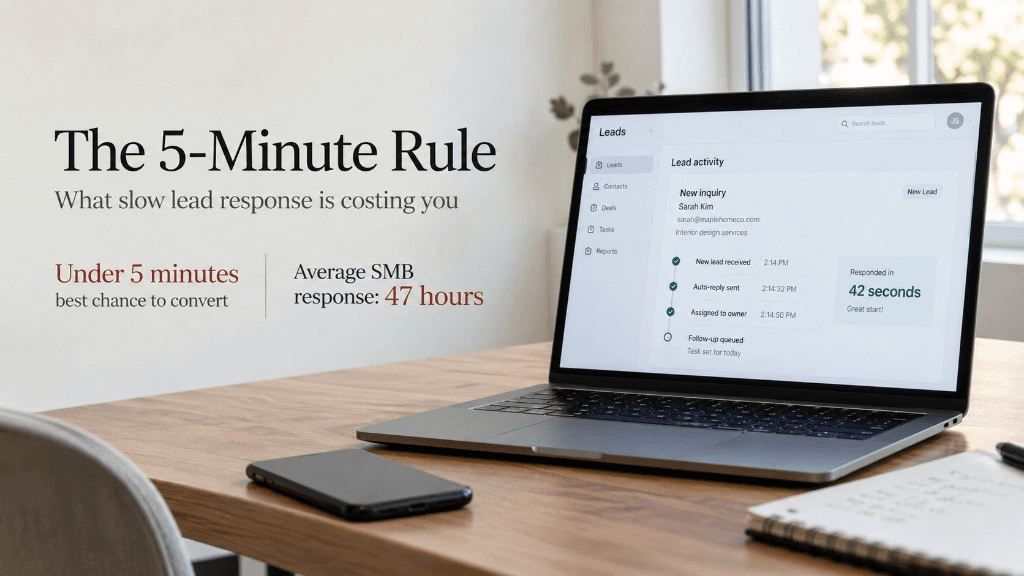
The stat that changes everything
In 2007, researchers at MIT and Harvard Business School published what is still the most-cited study in lead response. The finding was simple and brutal: leads contacted within 5 minutes are 100 times more likely to convert than leads contacted after 30 minutes.
Not 10x. Not 2x. One hundred.
The study has been replicated and re-validated multiple times since. For contractors and home service businesses in particular, the window is often shorter — a homeowner with a leaking pipe or a broken AC unit isn't comparing five quotes over a week. They're calling the first three companies that show up and hiring whoever answers first.
- After 30 minutes: 21x less likely to convert
- After 5 hours: the conversation is effectively over
- After 24 hours: you're a ghost to them
What actually happens to your leads
Here's the sequence that plays out in almost every contracting business without an automated response system:
A homeowner finds you online or gets your name from a neighbor. They fill out your contact form or call at 2:14pm on a Tuesday — while you're on a roof, under a sink, or mid-install with a customer.
You see the missed call or the form submission at 5:30pm. You're wrapping up the job. You mean to call back tonight. Something else comes up. You return the call the next morning at 9am — 19 hours later.
By then, they've already talked to two competitors. One called back in under 10 minutes. That company is now scheduled for an estimate. You're starting from zero — and you probably paid for that lead through ads, SEO, or a lead-gen platform.
Field-service benchmarks consistently show average response times measured in hours, not minutes — often a full business day or more.
What this is costing you
The math is straightforward, and it scales with your average job value:
If your average ticket is $3,000–$8,000 (a mid-size HVAC install, a re-roof, a remodel phase) and you close 30% of qualified leads when you respond fast — but only 5–10% when you respond slowly — every delayed response costs you real, calculable revenue.
At just 15 inbound leads a month and a conservative $600 opportunity cost per delayed response, that's:
$9,000/month. Over $100,000/year. From slow follow-up alone — before you spend another dollar on ads.
| Response Time | Conversion Likelihood | Expected Value Per Lead |
|---|---|---|
| Under 5 minutes | 100x baseline | Highest |
| 30 minutes | 21x less than 5-min | Sharply lower |
| 5 hours | Effectively zero | Near zero |
| 24+ hours | Gone | $0 |
What automated response actually looks like
Automated response does not mean a generic "thanks for your inquiry, we'll be in touch" text. That's not a system — that's an answering machine with extra steps.
A real automated response system does five things the moment a lead comes in, whether it's a web form, a missed call, or a message from a lead-gen platform:
1. Sends a reply in your voice within 60 seconds. Personalized to the job type and channel — a burst-pipe inquiry gets a different reply than a "get a quote for a kitchen remodel" form.
2. Creates a job record automatically. No one re-types the name, address, and job description into a scheduling board by hand.
3. Notifies the right person with full context. Not just "you have a new lead" — the notification includes the job type, the address, and what page or ad they came from.
4. Queues the follow-up sequence. If there's no reply to the first message within 24 hours, the system follows up again automatically — with a different angle, not the same text repeated.
5. Logs everything. Every touchpoint is recorded against the job. No more "I thought you already called them back."
How to build it
You do not need new software to do this. Most of it can be built on top of the scheduling tool, phone system, and forms you already have.
The stack:
Lead source (web form / missed call / lead-gen platform)
  → Trigger: new inquiry detected
  → Action: auto-reply sent within 60 seconds
  → Action: job record created in scheduling/CRM tool
  → Action: owner or dispatcher notified via SMS with job details
  → Action: follow-up sequence queued if no response in 24 hrs
  → Action: every touchpoint logged against the job
What this requires:
- A form or call system that can trigger on a new inquiry
- A scheduling/job board that accepts data automatically (most modern field-service platforms do)
- A notification channel — SMS is usually faster than email for a crew that's on the road
- One automation layer connecting them
The complexity isn't in any single tool. It's in making the phone, the form, and the job board talk to each other reliably, every time — including at 9pm on a Friday when the emergency call comes in. That's where most owners get stuck, and it's the exact gap we close.
Test every edge case before going live. What happens when two leads come in at once? What if the caller doesn't leave a callback number? What if the inquiry comes in at 2am? Map it and test each case before turning the system on.
Common mistakes to avoid
1. Using a generic auto-reply. "Thanks for reaching out, we'll be in touch" reads like a bot, because it is one. It should sound like a person who read what they asked for.
2. Building the system but skipping the edge cases. Simultaneous leads, missing information, after-hours calls — test each scenario before it goes live.
3. Notifying without context. "New lead" is useless on its own. Include the job type, address, and urgency so whoever picks it up can act immediately.
4. Setting it and forgetting it. Review reply rates and booked-rate from auto-response monthly. The system should keep improving.
5. Thinking this replaces the estimator. It doesn't. It handles the first 60 seconds so your team can focus on the conversation that actually books the job.
Proof this isn't theoretical
South Central Investment Group, a general contracting operation, was managing job scheduling and client updates across calls, texts, and spreadsheets — no central system, no automated response. After centralizing scheduling and client communication, daily coordination time dropped from 3–4 hours to under 1, freeing 50–60 hours a month to take on more work instead of chasing information.
Next steps
If you're still relying on someone checking voicemail or an inbox to follow up on new leads, you're leaving booked jobs on the table every week — jobs you likely already paid to generate.
The first step is seeing exactly where your current response process breaks down, and what that gap is actually costing you in booked revenue. Bring your last ten leads — won and lost — and we'll show you where the five minutes went.
Keep reading
Guide
The Question Your Office Answered Five Times This Week
A homeowner calls about an install quote. Then another texts about the warranty. Someone else wants to know what happens after the inspection. Your team knows the answer. It may live in the estimator’s head, an old text thread, or the office manager’s memory — so someone stops, checks the details, and types it again.

Guide
The AI Slowdown Debate — and What It Means for Your Business
Washington turned down requests from AI leaders to slow down. Markets fell, and paying customers filed lawsuits. Plus an AI that speaks 97 languages.
Guide
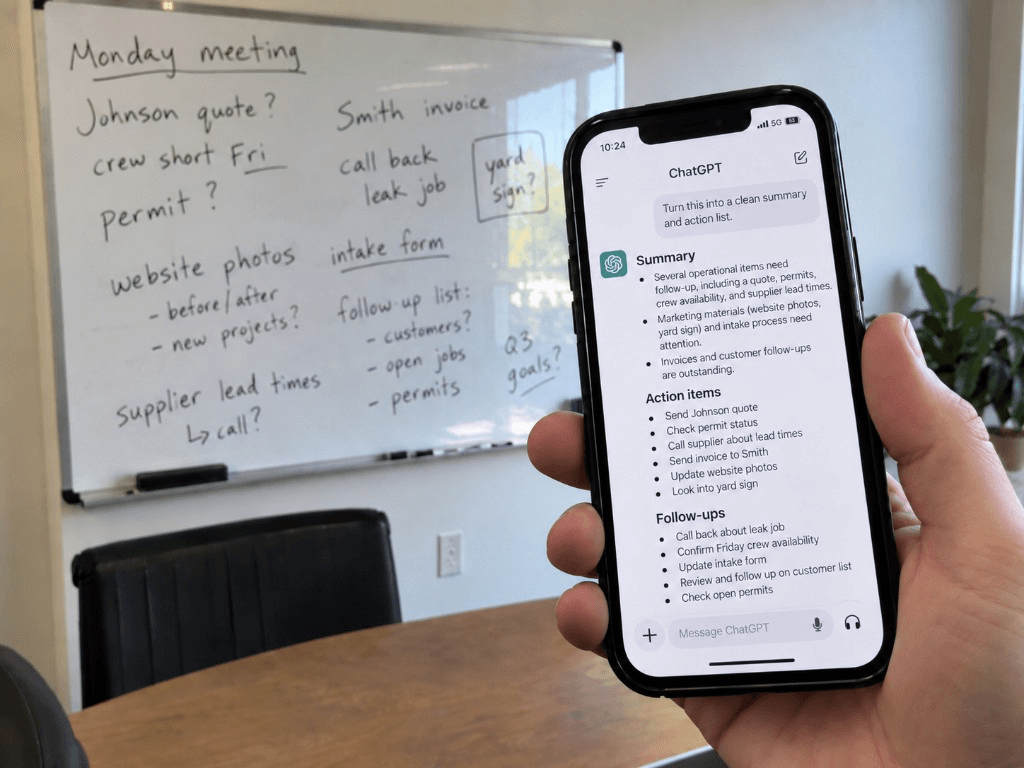
Stop Retyping Things That Are Already on Paper
Every AI app has a camera button. Most people have never pressed it. Here's what it actually does — and where it's genuinely useful for a trade or service business.
Let’s find the hours.
Bring your last ten quotes and a normal week off the schedule. Forty-five minutes is usually enough to see where it’s going.