Case Studies — General Contracting
South Central Investment Group: 50 Hours a Month Freed by Centralizing Jobs
Replaced scattered calls, texts, and spreadsheets with a centralized job management system — cutting daily admin from 4 hours to under 1.
Key results
- Daily admin dropped from 3–4 hrs to under 1 hr
- 50–60 hours a month recovered and redirected to additional projects
- Calls, texts, and spreadsheets replaced by one centralized system
- Client updates now automated — no manual communication required
- Team capacity increased without adding headcount
The problem
South Central Investment Group was managing job scheduling, client communication, and project updates across calls, texts, and spreadsheets. There was no central system — just a collection of manual touchpoints that required constant attention.
The owner was spending 3–4 hours every day coordinating: confirming schedules, updating clients, checking project status, answering the same questions repeatedly because there was no automated way for clients or the team to get answers themselves.
At that pace, taking on additional projects meant adding more hours to an already full day — the classic constraint every growing GC hits before they realize it's a systems problem, not a headcount problem.
What we found
The audit found a clear pattern: every coordination task was manual by default. Nothing was routing information or updating stakeholders on its own. The workflows themselves were simple and repeatable — exactly the kind that should run without a person in the loop, but invisible as a fixable cost until someone actually mapped the day.
What we built
A centralized job management and communication system designed around how a general contracting operation actually runs:
- Centralized scheduling across all active jobs
- Automated client update notifications at key project milestones
- Real-time project status tracking for the whole team
- Communication history logged per job
- Automated reminders reducing missed appointments and delays
The owner stopped being the communication layer between the team and the client.
The result
| Metric | Before | After |
|---|---|---|
| Daily coordination time | 3–4 hrs | Under 1 hr |
| Client updates | Manual calls/texts | Automated |
| Project visibility | Spreadsheets | Centralized system |
| Job capacity | Capped | Increased |
50–60 hours recovered every month — worth roughly $49,500/year at a conservative $75/hr operator rate.
"It gave me my day back." — Shahriar Shabazi, Owner, South Central Investment Group
What this means if you run a GC or design-build firm
If you're winning enough work that estimating and coordination are becoming the constraint — not the tools, not the crew — this is the pattern to look for: manual scheduling, manual client updates, and status living in someone's head instead of a system. Fixing that doesn't require new software so much as connecting what you already have.
Keep reading
Guide
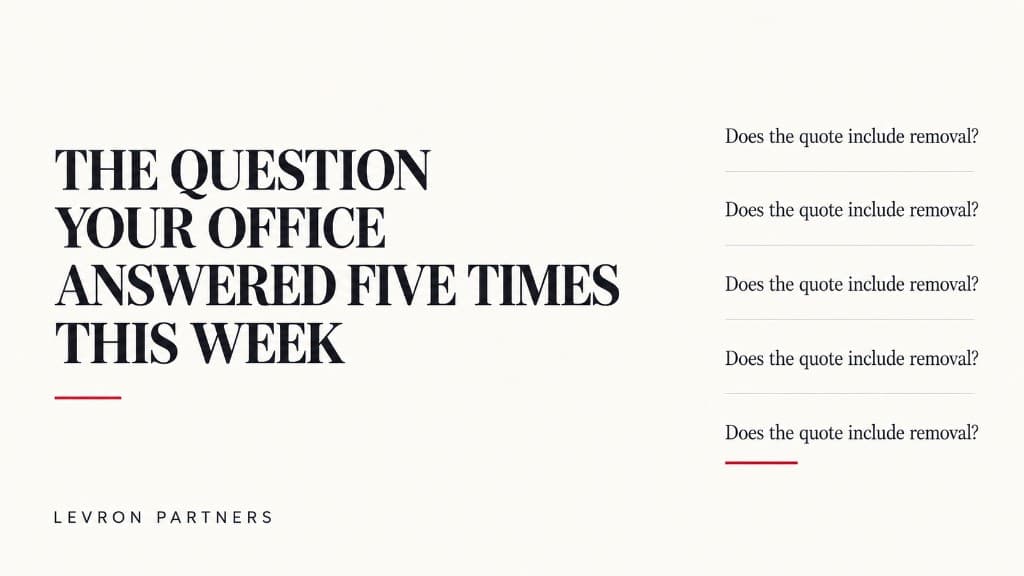
The Question Your Office Answered Five Times This Week
A homeowner calls about an install quote. Then another texts about the warranty. Someone else wants to know what happens after the inspection. Your team knows the answer. It may live in the estimator’s head, an old text thread, or the office manager’s memory — so someone stops, checks the details, and types it again.

Guide
The AI Slowdown Debate — and What It Means for Your Business
Washington turned down requests from AI leaders to slow down. Markets fell, and paying customers filed lawsuits. Plus an AI that speaks 97 languages.
Guide
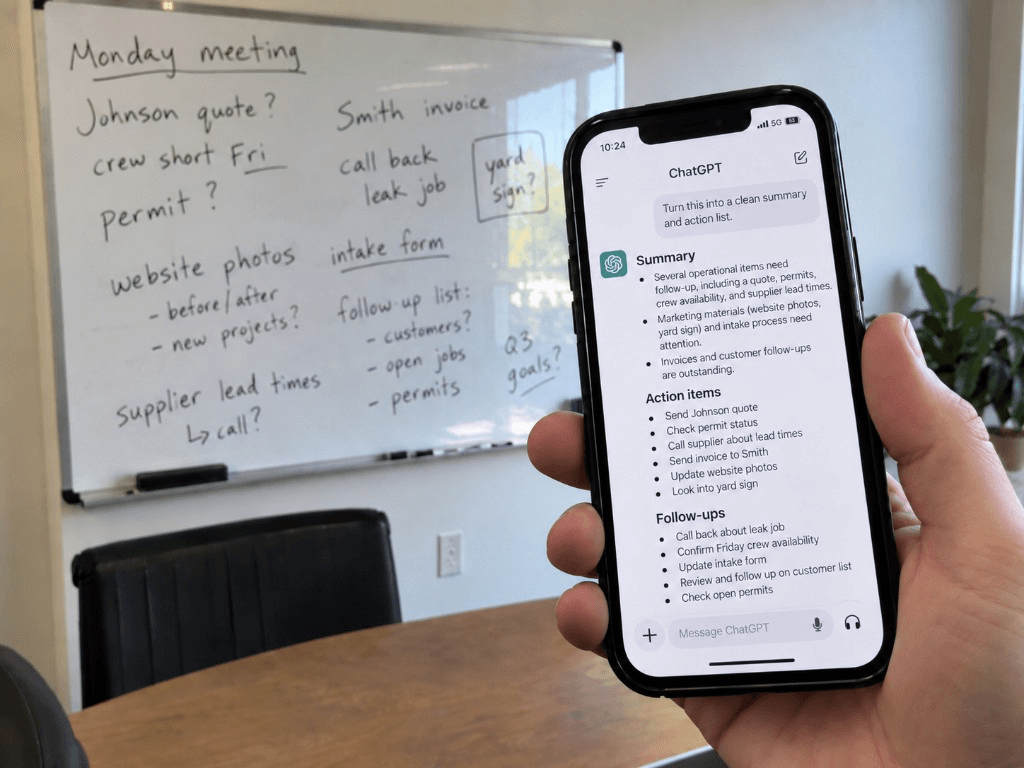
Stop Retyping Things That Are Already on Paper
Every AI app has a camera button. Most people have never pressed it. Here's what it actually does — and where it's genuinely useful for a trade or service business.
Let’s find the hours.
Bring your last ten quotes and a normal week off the schedule. Forty-five minutes is usually enough to see where it’s going.