Home Service & Contractor Ops
The True Cost of Manual Work: What Office Admin Actually Costs Your Contracting Business
Most owners guess. Here's the simple formula for what manual admin really costs a contracting or home service business per year — and the threshold where automation pays for itself.
Why nobody knows this number
Ask a contractor what materials cost this quarter and they'll answer to the dollar. Ask what manual admin costs and they'll shrug.
That's because admin doesn't arrive as an invoice. It arrives as fifteen minutes here — re-typing a job into the schedule, confirming an appointment by phone, building the same quote again from scratch — spread across every day, every person, forever. No line item, no budget review, no decision point. It just quietly compounds, the same way a small leak costs more than the one big one everyone notices.
Here's the formula to make it visible.
The formula
Annual cost of a manual workflow =
  (hours per week × loaded hourly rate × 52)
  + (errors per year × average cost per error)
  + opportunity cost of who is doing it
Loaded hourly rate means wage plus taxes, benefits, and overhead — typically 1.25–1.4× the wage. If the person doing the admin is you, use what an hour of your bidding or field time is actually worth, not what you pay yourself on paper.
A worked example
A contracting business where the owner spends 2 hours a day coordinating jobs, and one office admin spends 90 minutes a day re-keying data between the phone, a spreadsheet, and a scheduling tool:
| Line | Math | Annual cost |
|---|---|---|
| Owner coordination | 10 hrs/wk × $100/hr × 52 | $52,000 |
| Staff re-keying | 7.5 hrs/wk × $34/hr × 52 | $13,260 |
| Errors (bad entries, missed follow-ups, double-booked jobs) | 2/mo × $250 | $6,000 |
| Total | $71,260 |
This is a real pattern, not a scare number. Our client results land in the same band: South Central Investment Group recovered roughly $49,500 a year by centralizing job scheduling and client updates, and Kung Fu Air Service recovered roughly $39,000 a year just from automating quoting — both from fixing workflows exactly like these.
Why your estimate is too low
When owners self-report admin time, then actually track a week, the tracked number comes in 40–60% higher. Three reasons:
1. Switching cost is invisible. A "2-minute" data entry task costs closer to 10 once you count getting back into what you were doing — especially mid-estimate or mid-call.
2. You only count the big blocks. The Sunday-night invoicing session gets counted. The 30 daily micro-interruptions from the phone don't.
3. Someone else absorbs part of it. The workflow you touch for 5 hours a week usually consumes another 5 somewhere downstream — dispatch, billing, or the crew waiting on information.
So before trusting the formula, track one normal week. A notes app is enough: every time you do something repetitive, log it and the minutes. Seven days of honest logging beats any estimate.
The automation threshold
The rule of thumb we use in every capacity call:
| Weekly manual hours on one workflow | Verdict |
|---|---|
| Under 2 hrs | Leave it alone |
| 2–5 hrs | Automate it if it's error-prone or customer-facing |
| 5+ hrs | Automation pays for itself — usually within months |
| 10+ hrs | You're funding a phantom part-time salary |
One workflow at 5+ hours a week is worth $13,000–$26,000 a year at typical loaded rates. That's the budget you're already spending — just invisibly, on the most expensive labor you have.
Next steps
Run the formula on your worst workflow — the one you'd hand off first if you could. If it clears 5 hours a week, you now know what doing nothing costs.
The next question is what fixing it costs, and that's exactly what a capacity call answers. Bring your last ten quotes and a normal week off the schedule; in about 45 minutes we can usually show you where the hours are leaking and what a fix is worth.
Keep reading
Guide
The Question Your Office Answered Five Times This Week
A homeowner calls about an install quote. Then another texts about the warranty. Someone else wants to know what happens after the inspection. Your team knows the answer. It may live in the estimator’s head, an old text thread, or the office manager’s memory — so someone stops, checks the details, and types it again.

Guide
The AI Slowdown Debate — and What It Means for Your Business
Washington turned down requests from AI leaders to slow down. Markets fell, and paying customers filed lawsuits. Plus an AI that speaks 97 languages.
Guide
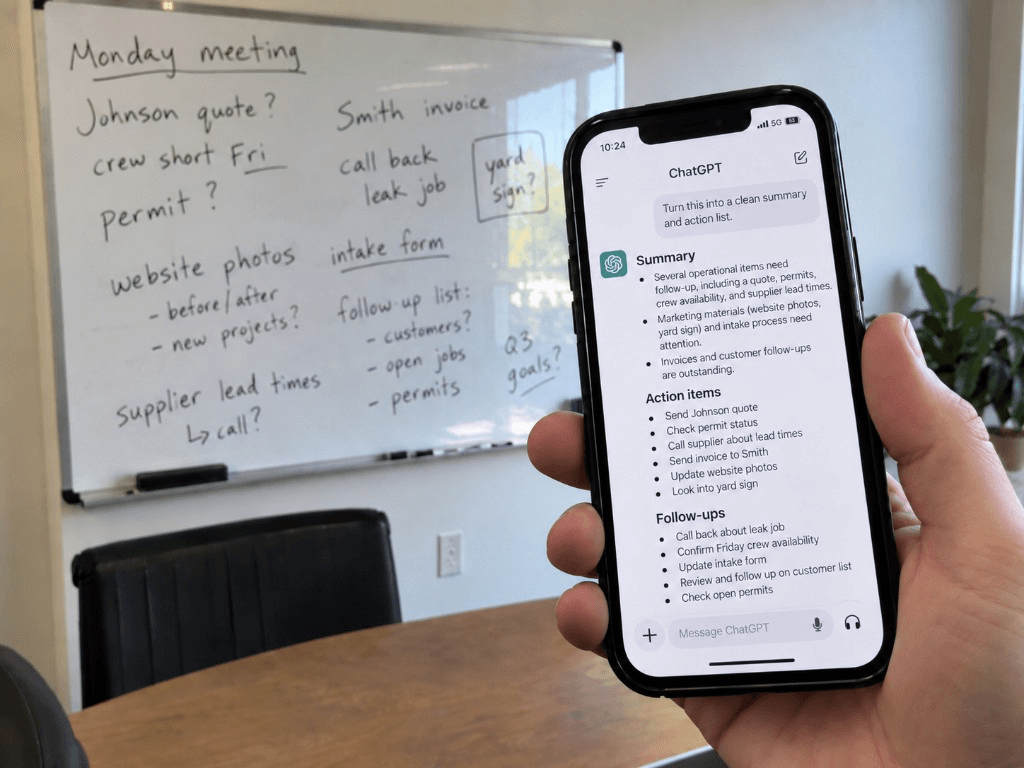
Stop Retyping Things That Are Already on Paper
Every AI app has a camera button. Most people have never pressed it. Here's what it actually does — and where it's genuinely useful for a trade or service business.
Let’s find the hours.
Bring your last ten quotes and a normal week off the schedule. Forty-five minutes is usually enough to see where it’s going.